
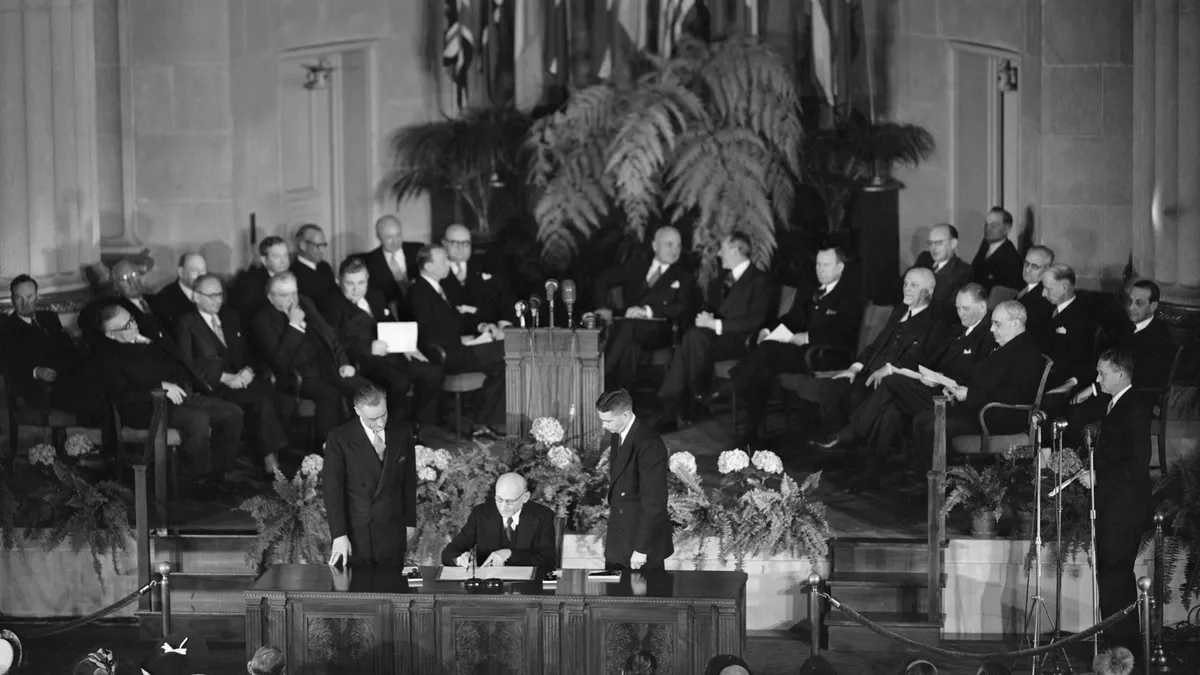
“NATO is a paper tiger,” remarked former President Donald Trump, a statement that has sparked discussions about the organization’s strength and relevance in today’s geopolitical landscape. NATO, which stands for the North Atlantic Treaty Organization, was established to ensure collective defense among its member nations, primarily in response to threats during the Cold War.
The significance of NATO lies in its Article 5, which states that an attack on one member is an attack on all. This principle is underpinned by the military support and nuclear assurance provided by the United States, which has historically played a crucial role in NATO’s collective defense.
In recent developments, NATO Secretary General Mark Rutte emphasized, “The US umbrella remains the ultimate guarantor of European security.” This statement underscores the importance of US involvement in maintaining stability within the alliance.
However, the dynamics of NATO are shifting. According to Section 1250A of the 2024 National Defense Authorization Act, the president may not withdraw from NATO without two-thirds Senate consent or an Act of Congress. This legal framework highlights the complexities surrounding potential changes in US commitment to NATO.
Moreover, NATO’s treaty requires a one-year notice before any withdrawal takes effect. A formal US withdrawal from NATO would be catastrophic, not only for the alliance but also for global security.
In light of these challenges, NATO’s European members and Canada have increased their defense spending by 20% in 2025, demonstrating a commitment to bolstering their military capabilities. Countries like Poland, Lithuania, and Latvia have surpassed the 3.5% GDP benchmark for core defense spending, reflecting a proactive approach to regional security.
Yet, a NATO without US backing would necessitate the establishment of a local operational core, potentially centered around Britain, France, Germany, Poland, and the Baltic-Nordic states. This shift could redefine the alliance’s structure and effectiveness in responding to threats.
As NATO navigates these complexities, the future of the organization remains uncertain. The ongoing discussions about its meaning and role in global security will be crucial in shaping its path forward.