
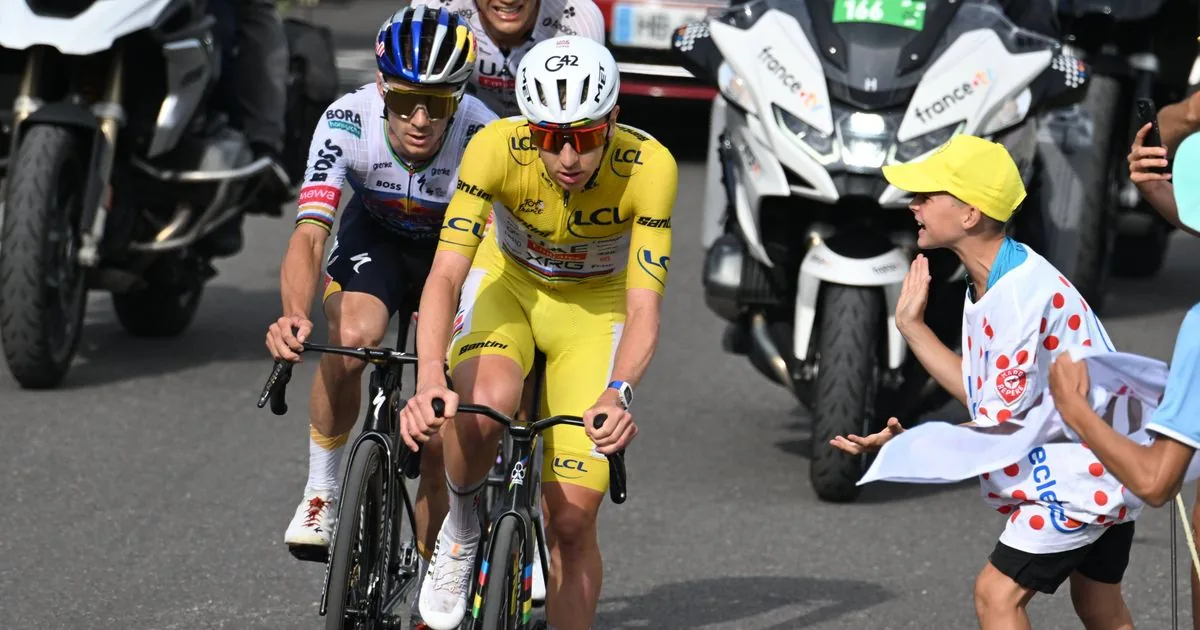
Jasper Philipsen of Alpecin-Premier Tech achieved a significant milestone on Wednesday, securing a Tour de France stage victory. This win marks his 11th career stage triumph in the race. The 28-year-old Belgian rider acknowledged the pressure he felt to succeed, especially with limited opportunities remaining before the final stage in Paris.
Philipsen has consistently performed well in previous editions of the Tour de France, securing at least one stage win each year since 2022. His most successful year was 2023, with four victories. In 2025, he claimed one stage win, and his performance in 2026 saw him place within the top five five times before his recent win on Wednesday.
Stage 17 victory and team support
The decisive moment came on stage 17, a tactically complex race through the Alpine foothills. A strong lead-out from teammate Mathieu van der Poel, emerging from a 40-rider group, propelled Philipsen to victory. This stage was considered one of the last opportunities for sprinters before the race heads into the mountains for three consecutive days.
Philipsen admitted that handling the team’s expectations for a win had been challenging. He explained that despite no explicit pressure, the team’s focus on stage victories, especially with a full lead-out squad, created an inherent expectation. He sought to manage this by engaging in activities unrelated to cycling during his downtime.
The Belgian rider highlighted the crucial role of Van der Poel in his success. He noted that Van der Poel’s presence in the early breakaway group helped control the race, and his lead-out in the final kilometers was instrumental in securing the win. Philipsen acknowledged that having Van der Poel as a lead-out rider is a privilege, despite the added pressure to deliver.
Van der Poel himself mentioned feeling fatigued after the stage, but Philipsen commented that many riders experience similar exhaustion in the third week of the Tour. He expressed satisfaction with Van der Poel’s effort, especially given the demanding nature of stage 17, which was not a typical sprint stage.
Green jersey aspirations
With this stage win, Philipsen has significantly narrowed the gap in the points competition, now trailing Mads Pedersen (Lidl-Trek) by just seven points. Philipsen, who won the points classification in 2023, indicated that he would not rule out a late challenge for the green jersey in Paris.
However, he recognized the difficulty of this goal, particularly with the upcoming mountain stages. Pedersen gained 25 points in an intermediate sprint on Wednesday, and Philipsen anticipates that he may not be able to contest the intermediate sprints in the mountains, potentially allowing Pedersen to extend his lead.
The Tour de France 2026 features a diverse route, including a team time trial on stage 1 and an individual time trial on stage 16. The race also includes seven stages likely to conclude in a bunch sprint, such as stages 5, 7, 8, 11, 12, and 17, with potential sprint finishes in Foix (stage 4) and Paris (stage 21).
Stages 9 and 13 are designed for breakaway specialists, offering opportunities in hilly profiles during the initial weeks. The mountain stages encompass a day in the Pyrenees (stage 6) with a summit finish in Gavarnie-Gedré, Le Lioran (stage 10) in the Massif Central, and Le Markstein (stage 14) in the Vosges, before the race enters the Alps.
The Alps will host a summit finish at Plateau de Solaison (stage 15) at the end of the second week. The final week includes a summit finish in Orcieres-Merlette (stage 18) and two arrivals at Alpe d’Huez on stages 19 and 20. Stage 18, covering 185.2 kilometers from Voiron to Orcieres-Merlette, is anticipated to favor a breakaway due to the GC riders conserving energy for the more demanding later mountain stages.
The climb on stage 18 is 7.1 kilometers long with an average gradient of 6.7%, offering opportunities for attacks despite not being considered hard enough to create significant differences among the main GC contenders. Stage 19, a 127.9-kilometer route from Gap to Alpe d’Huez, features an uphill start with the Col Bayard and Col du Noyer in the opening 25 kilometers.
Source: cyclingnews.com