
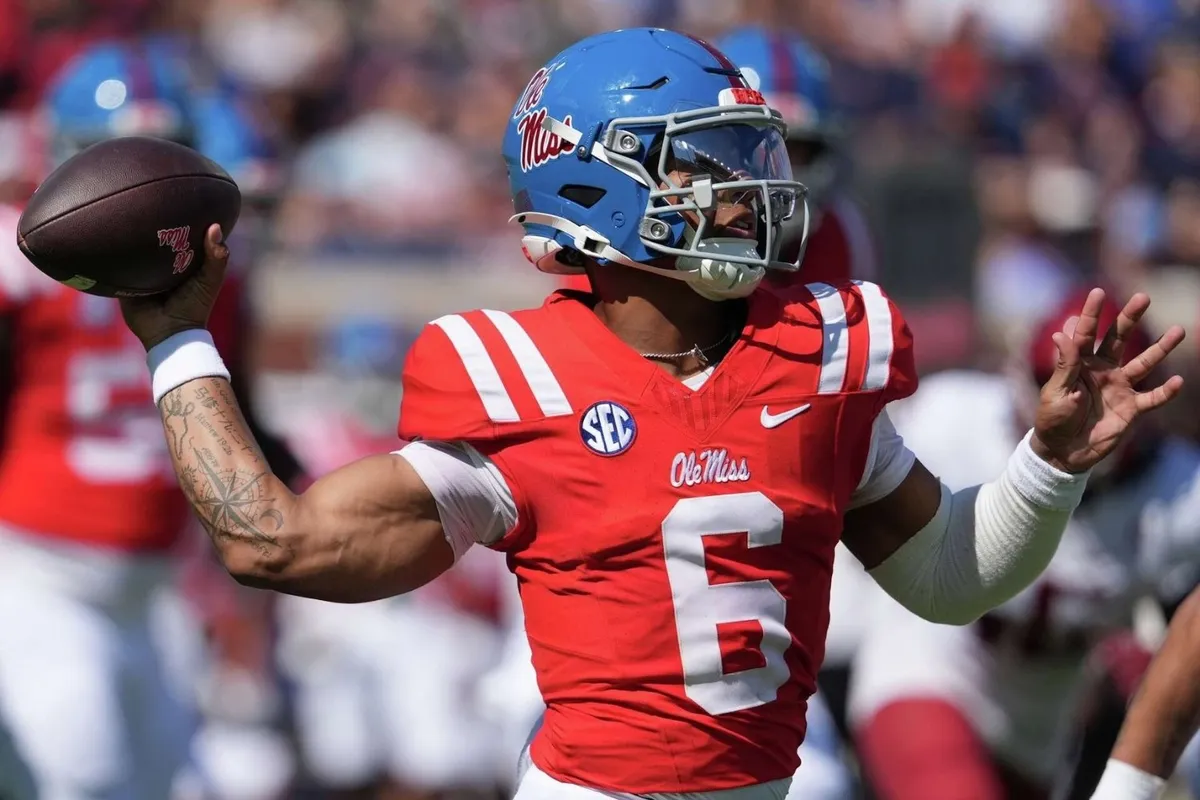
Reaction from the field
The Mississippi Supreme Court’s recent decision to deny the NCAA’s petition to appeal a preliminary injunction for Trinidad Chambliss has significant implications for college football. Chambliss, a quarterback who transferred to Ole Miss from Ferris State, is now set to play in the 2026 season after overcoming a series of health challenges that hindered his development during his earlier college years.
In February 2026, Judge Robert Whitwell ruled in favor of Chambliss, granting him a sixth year of eligibility. This ruling came after Chambliss faced health issues, including recurrent throat infections and fatigue, which stemmed from a bout of infectious mononucleosis in 2020. These medical complications prevented him from playing during the 2022 season at Ferris State, leading to his application for a retroactive medical redshirt.
Chambliss’ performance at Ole Miss has been impressive. Last season, he threw for 3,937 yards, completing 22 touchdown passes while only throwing three interceptions. His contributions were pivotal in leading Ole Miss to two College Football Playoff wins, and he was recognized as the SEC newcomer of the year. His ability to perform at such a high level despite his earlier setbacks speaks volumes about his resilience and talent.
After transferring to Ole Miss before the 2025 season, Chambliss applied for an additional year of eligibility following the Rebels’ final game. Initially, the NCAA denied his waiver request on January 9, 2026, but the subsequent court ruling has allowed him to continue his college career. The NCAA’s attempt to bar him from playing has been thwarted, at least for now, as the Mississippi Supreme Court stated, “We find that the petition should be denied.”
Chambliss’ case is particularly noteworthy as it highlights the ongoing debates surrounding athlete eligibility and the impact of health issues on a player’s career. His situation reflects a broader concern within college sports regarding how governing bodies like the NCAA handle medical redshirt requests and the complexities involved in such decisions.
Despite the positive ruling for Chambliss, uncertainties remain. The overall lawsuit ruling regarding his eligibility is not expected to be settled before the season ends, and it is unclear if the NCAA will file a motion for another hearing regarding his case. Details remain unconfirmed, leaving fans and analysts alike eager to see how this situation unfolds.
As the 2026 season approaches, the focus will undoubtedly be on Chambliss and his performance on the field. With a strong season behind him and a chance to further prove himself, he has the opportunity to solidify his legacy at Ole Miss and in college football.