
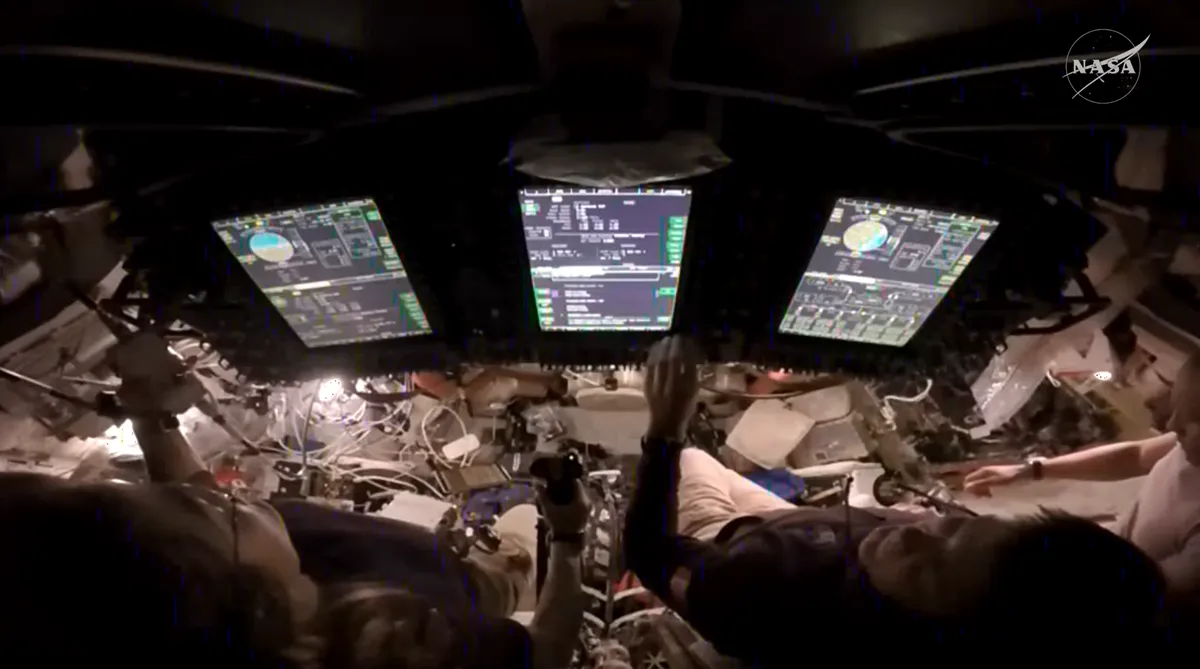
The NASA Artemis II mission is poised to make history as the first crewed lunar mission in over 50 years, with a launch scheduled for April 4, 2026. The crew, consisting of four astronauts—Reid Wiseman, Victor Glover, Christina Koch, and Jeremy Hansen—will embark on a ten-day journey to the Moon.
On flight day four, the Artemis II crew successfully completed a 41-minute manual piloting demonstration, showcasing their skills as they prepare for the mission ahead. During their flyby, the astronauts will observe the Moon from approximately 4,000 miles above its surface, capturing images of distinctive features such as the Orientale basin and Ohm crater.
Reid Wiseman expressed the unique perspective they will gain, stating, “The Earth is almost in full eclipse. The moon is almost in full daylight, and the only way you could get that view is to be halfway between the two entities.” This mission will allow the crew to be the first humans to see the far side of the Moon while it is illuminated.
The Orion capsule, which will carry the astronauts, has a habitable volume roughly equivalent to a camper van, measuring 16.5 feet wide. The crew has memorized 15 distinctive features to photograph during their flyby, enhancing the scientific value of their observations.
As they prepare for this historic mission, Christina Koch remarked, “Being human up here is one of the coolest things about this mission.” The crew is expected to observe lunar features for about six hours on April 6, further contributing to our understanding of the Moon’s geology.
The Orientale basin, which the crew will examine, formed approximately 3.8 billion years ago and was created by an impact that caused two hours of sloshing around in the lunar surface. These insights will be invaluable as NASA aims to return humans to the Moon and eventually prepare for future missions to Mars.
As the launch date approaches, excitement builds within the space community. Kelsey Young, a mission planner, emphasized the importance of human observation, stating, “The human eye is the most nuanced detector there is, especially when connected to a well-trained human brain.”
With the Artemis II mission, NASA is not only reviving lunar exploration but also setting the stage for future endeavors in deep space. Observers eagerly await the crew’s findings and the impact they will have on our understanding of the Moon.
Details remain unconfirmed as the mission date approaches, but the anticipation surrounding this historic journey continues to grow.