
Lewis Hamilton secured the top position in Free Practice 2 for the Hungarian Grand Prix, outpacing Charles Leclerc and Lando Norris. The session saw several teams working to fine-tune their car upgrades, including Aston Martin, after Lance Stroll experienced a suspension issue that cut short his FP1 session.
The Silverstone-based team arrived in Hungary with significant updates, introducing what has been described as a B-spec car. McLaren also brought a substantial new package, while Red Bull re-introduced their rotating rear wing. The 60-minute session commenced at 17:00 local time.
Stroll did not participate in FP2 as his team lacked sufficient time to repair the damage from earlier in the day, leaving Fernando Alonso as the sole representative for Aston Martin. Alonso continued to gather data on their revised car.
Early in the session, Leclerc set an initial benchmark of 1m 20.103s on medium tires, which Hamilton then surpassed by four-tenths of a second. The Ferrari drivers demonstrated strong performance from the outset.
However, not all drivers were content with their cars. Pierre Gasly reported issues, stating, “Something feels wrong on the car, it’s extremely bad. It just feels broken in Turn 12. Something with the front is wrong.”
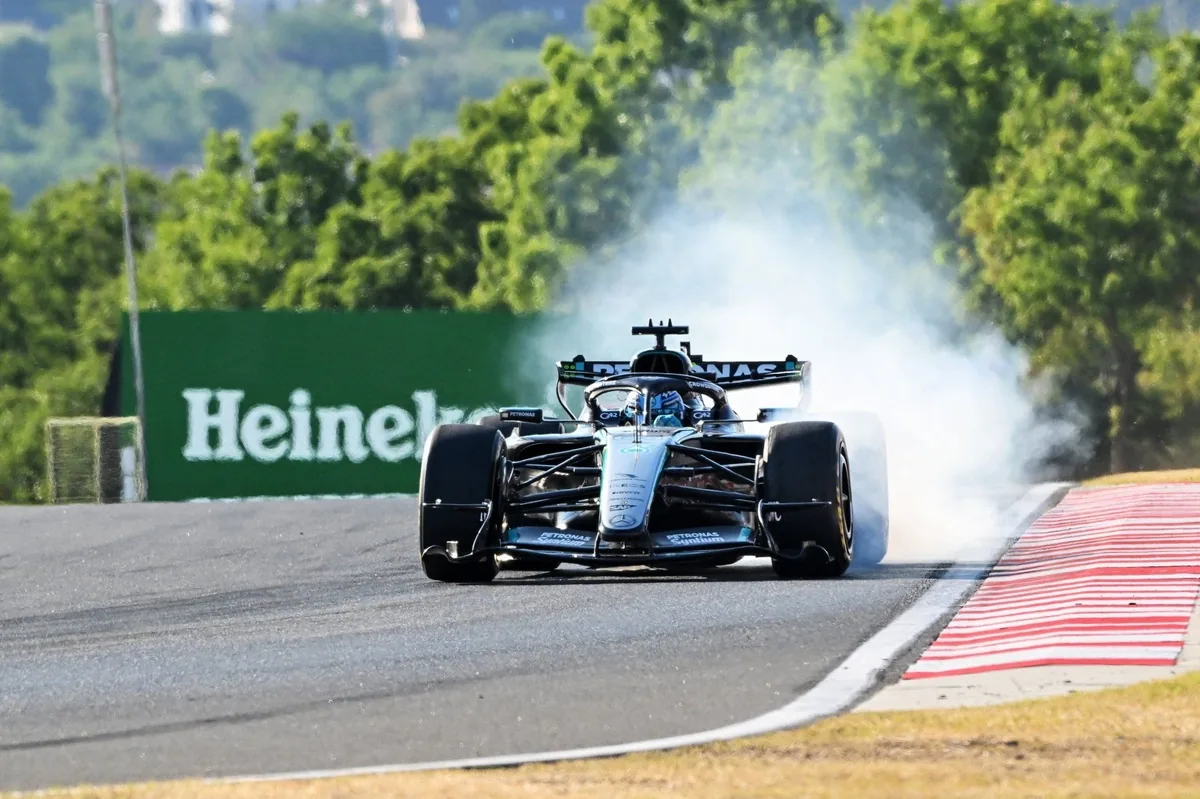
As wind conditions intensified, balance around the circuit became a challenge for many. George Russell described his Mercedes as “dreadful” and “so out of balance.” His teammate also questioned his car’s behavior, noting he “almost spun twice on braking.”
Despite the difficulties faced by competitors, Hamilton improved his time to maintain the lead. Leclerc, in the second Ferrari, experienced three lock-ups within the first 20 minutes before returning to the pits.
The subsequent soft tire runs saw Norris complete the fastest lap of the session in his upgraded McLaren, recording a time of 1m 19.228s. The session was briefly interrupted by a red flag after Franco Colapinto crashed, forcing Kimi Antonelli to abort his flying lap.
Colapinto lost control at the final corner, spinning backwards into the barrier, which will require an overnight repair for Alpine. After the recovery of his car, qualifying simulation laps resumed.
Ferrari then showed strong pace at the Hungaroring, with Leclerc retaking the top spot with a time of 1m 18.877s. Hamilton followed closely, just 0.037s behind.
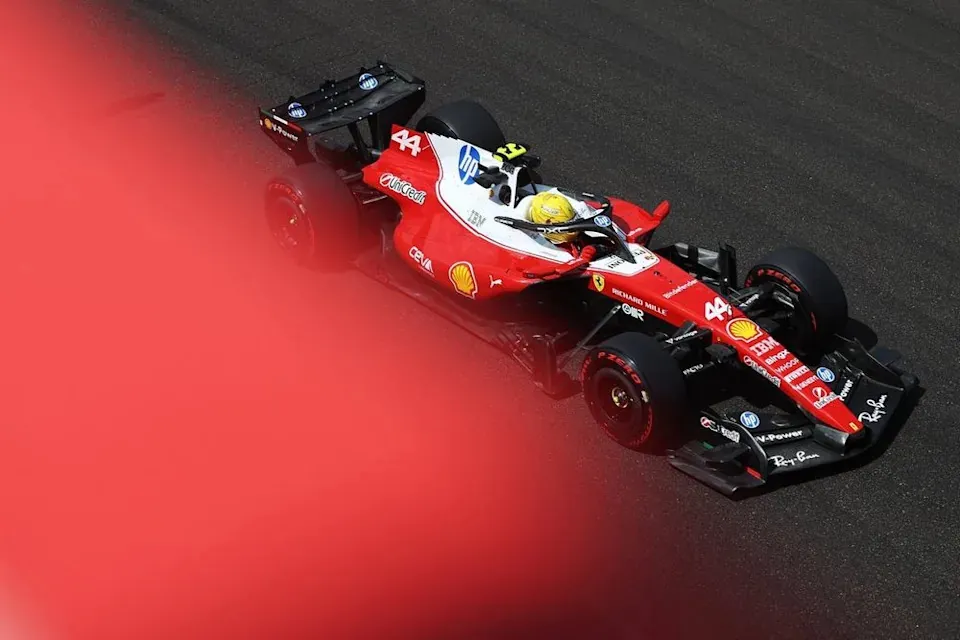
However, Hamilton further reduced his time, establishing an advantage of more than a tenth over his teammate. His final effort of 1m 18.729s remained the best of the day as the focus shifted to long runs. He concluded FP2 ahead of Leclerc and Norris.
Max Verstappen secured fourth place for Red Bull after encountering debris from Alonso’s Aston Martin. He was followed by Russell, Isack Hadjar, and Liam Lawson. Oscar Piastri finished seventh, with Nico Hulkenberg and Arvid Lindblad completing the top ten.
The remaining positions included Gabriel Bortoleto, Esteban Ocon, Antonelli, Gasly, Ollie Bearman, and the Williams duo of Alex Albon and Carlos Sainz. Valtteri Bottas, Alonso, Sergio Perez, and Colapinto in his damaged Alpine rounded out the order, while Stroll remained in the garage for the entire session.
Ferrari’s Performance and Mercedes’ Concerns
Ferrari’s SF-26 demonstrated its strength in slower corners during the opening day of track action. Leclerc was the fastest in FP1, and in FP2, Hamilton led Leclerc in a Ferrari 1-2. This performance confirmed concerns expressed by Mercedes regarding Ferrari’s pace in such conditions.
In contrast, both Mercedes drivers reported issues with balance and grip. Other drivers also noted bumps and a poor-quality track surface, despite recent resurfacing efforts on parts of the track. Russell commented on the “strange day” and the track’s condition, noting that “what we essentially feared with Ferrari seemed to be the case.”
The Hungaroring is known for being a challenging track due to its infrequent use compared to other F1 circuits, which often results in a dusty and ‘green’ surface at the start of the weekend. This surface evolves rapidly throughout practice sessions. The track’s bumpiness further complicates driving, especially with the latest generation of cars, where sliding can be penalized by power unit control software.
The SF-26 had previously gained a reputation for its speed in slow and medium-speed corners earlier in the season. While it was considered a strong contender for the Monaco GP, Hamilton secured a win in Barcelona and Leclerc at Silverstone, tracks that were not traditionally seen as favorable to Ferrari’s technical package.
Setting up a car at the Hungaroring requires a delicate balance. The circuit’s configuration, with numerous corners demanding high traction on exit, makes the rear axle a limiting factor. However, adjusting for understeer to protect the rear tires can negatively impact entry speeds. In FP2, Russell’s fastest lap was 0.933s slower than Hamilton’s benchmark. Antonelli was 1.964s off, placing 13th overall, but did not complete a representative lap due to the red flag and a subsequent lock-up.
Despite the challenges, Mercedes remained confident about their prospects for pole position. Deputy team principal Bradley Lord stated that the team has been competitive across various circuit types this year and aims to compete for pole at every race.
Looking Ahead to Qualifying
The evolving track conditions and the varying performance across teams suggest that qualifying for the Hungarian Grand Prix could be competitive. The balance issues reported by some drivers, combined with the strong pace shown by Ferrari and Hamilton, set the stage for an interesting session.
Teams will be working to optimize their car setups to manage the track’s unique characteristics, including its bumpiness and the demands for high traction. The performance seen in FP2, particularly Hamilton’s leading time of 1m 18.729s, will be a key reference point for adjustments ahead of the next sessions.
The incident involving Colapinto highlights the low grip at the final corner, a factor that drivers will need to manage carefully. The need for overnight repairs for Alpine following the crash also adds to the challenges for that team.
The differing performances and reported car behaviors across the grid indicate that teams will be analyzing data closely to find improvements. The focus will be on addressing balance issues and maximizing grip to gain an advantage in the upcoming qualifying session.
The session ended with Hamilton maintaining his top position, setting the fastest time of the day.
Source: formula1.com