
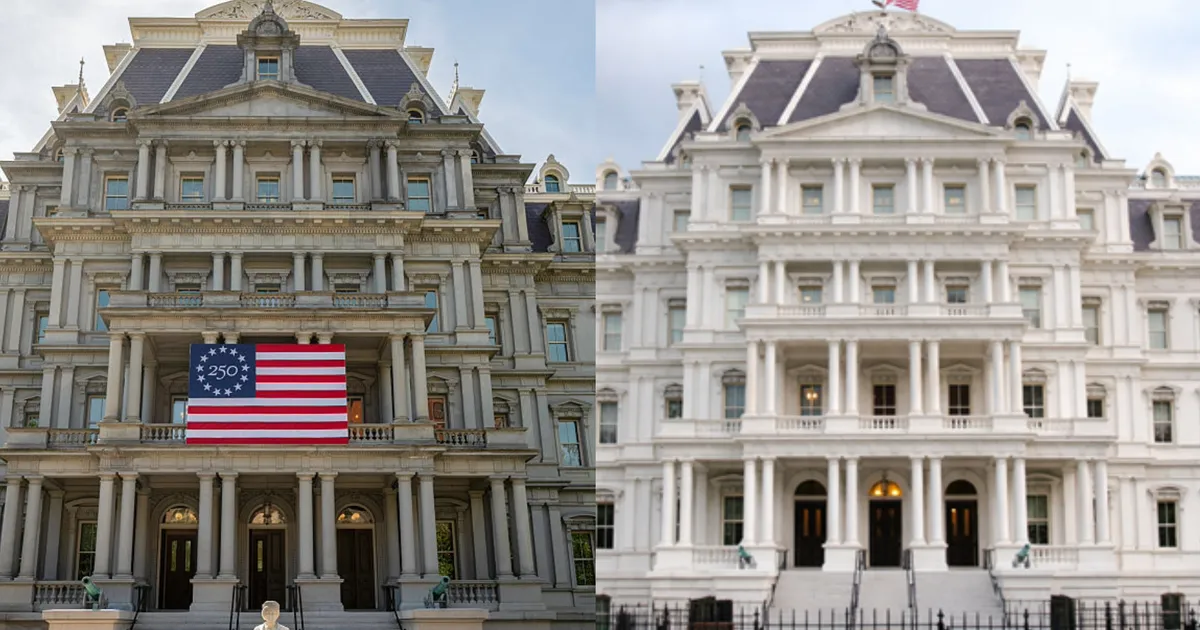
In a surprising development, former President Donald Trump has unveiled plans to repaint the historic Eisenhower Executive Office Building in Washington D.C. with a bright white color using a product he refers to as ‘magic paint with silicate.’ This announcement has raised eyebrows and sparked debates among preservationists and experts alike regarding the suitability of the proposed paint for the building’s granite exterior.
The Eisenhower Executive Office Building, completed in 1888 and designed in the French Second Empire style, has served as ancillary office space for the president’s staff and has been largely neglected since its construction. Trump’s proposal includes two options: either painting the entire building white or leaving the granite basement exposed. While the idea of revitalizing the building may seem appealing, experts have raised significant concerns about the implications of using mineral silicate paints on granite.
According to experts, mineral silicate paints are not suited for use on granite, and their application could lead to irreversible damage to the building’s surface. The paint is marketed as a solution that would strengthen the stone, keep water out, and prevent staining, but experts caution that these claims may not hold true for the historic structure. “Mineral silicate paints are not suited for use on granite,” one expert noted, emphasizing the potential risks involved.
The Commission of Fine Arts is currently reviewing the proposal, which has drawn criticism from various preservationist groups. These groups assert that moving forward with the painting project would be illegal, given the building’s historical significance and the potential harm to its integrity. The White House has acknowledged the building’s neglected state, stating, “The existing structure has been largely neglected since its construction in the late 1800s.” This acknowledgment highlights the ongoing challenges faced in maintaining such an important piece of American architecture.
Despite the controversies surrounding the proposal, Trump remains optimistic about the benefits of the ‘magic paint.’ He claims that it would be easy to apply and rarely require repainting, which could be seen as a cost-effective solution for maintaining the building. However, the juxtaposition of these claims against expert warnings raises questions about the feasibility and wisdom of the plan.
The Eisenhower Executive Office Building originally housed the State, War, and Navy departments, making it a site of significant historical importance. As discussions about its future continue, the potential repainting project serves as a focal point for broader conversations about preservation and modernization in historic contexts.
As the Commission of Fine Arts prepares to review the proposal for the first time, stakeholders from various sectors are closely watching the developments. The outcome of this review could set a precedent for how similar projects are approached in the future, particularly those involving historically significant structures.